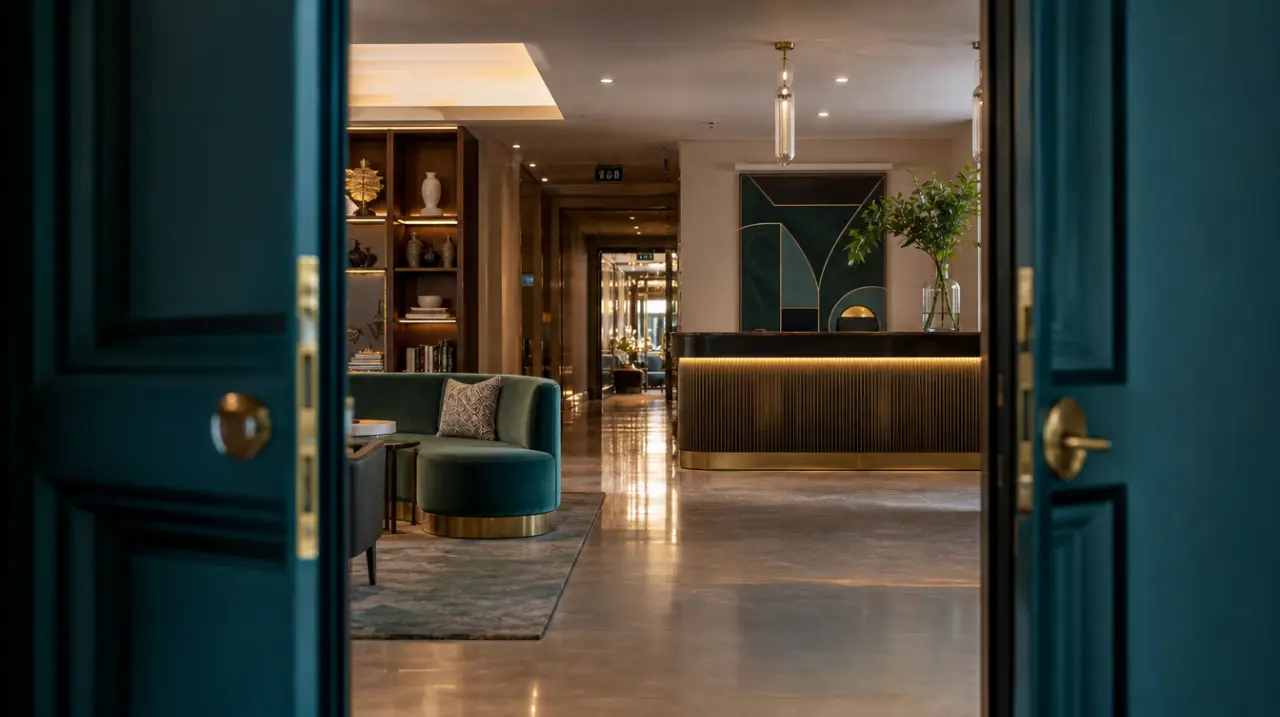
FF&E stands for furniture, fixtures, and equipment. In a hotel context it is the movable, non-structural property that outfits a building and makes it operable as a lodging asset. A useful field test, quoted often across the industry, is that if you could pick up the building and shake it, everything that fell out would be FF&E. Everything that stayed bolted to the structure is not.
For hotel owners, developers, asset managers, and procurement teams, FF&E is both a design category and a distinct financial category. It sits between the building itself, which is real property, and the operating supplies a hotel consumes day to day. Understanding where those lines fall governs how a project is budgeted, how the capital stack is underwritten, how the asset is depreciated, and how much an owner must set aside each year to keep the property competitive.
The three components
The acronym separates three groups of items that behave differently in a spec book and on a balance sheet.
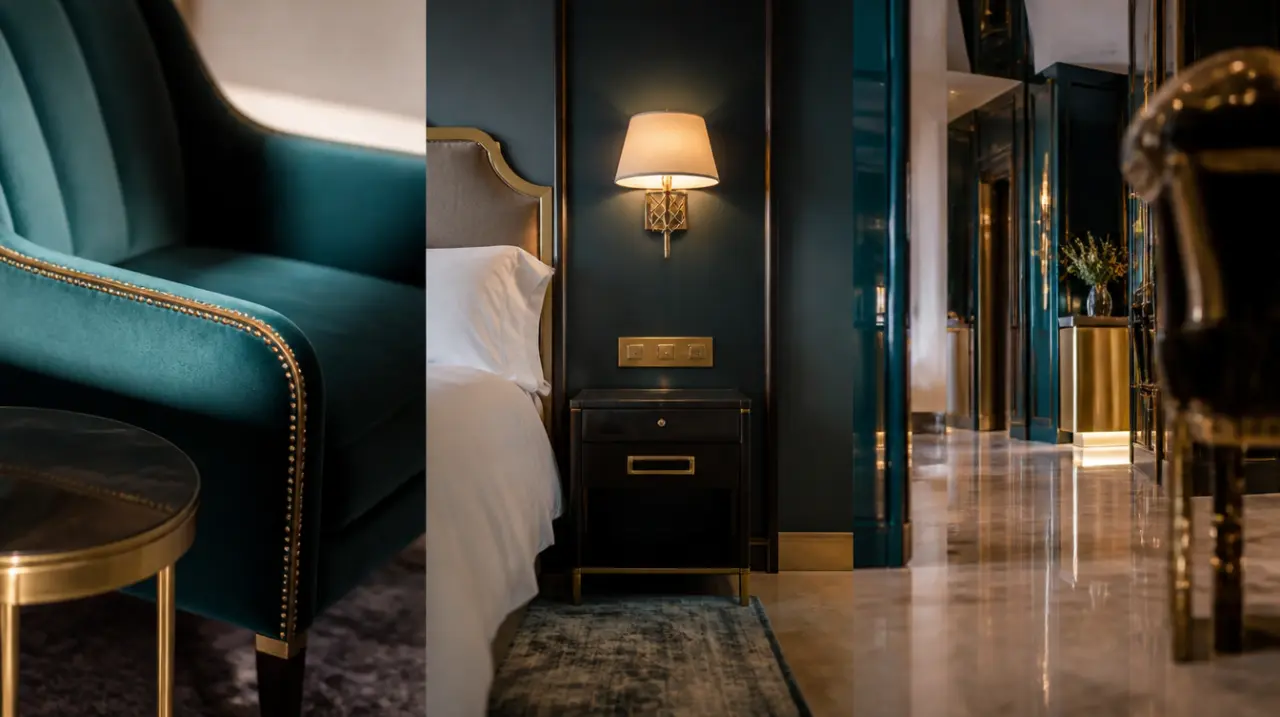
Furniture is the movable case and upholstered goods a guest and staff interact with directly: guestroom beds, headboards, nightstands, desks, luggage benches, lounge and dining seating, casegoods, wardrobes, and lobby and public-area furniture. Casegoods and seating usually represent the largest single share of a guestroom FF&E package.
Fixtures are the semi-permanent items that are attached to the building but are not part of its structure and are typically installed as part of the FF&E scope rather than the base construction. Decorative lighting, mirrors, artwork, window treatments, and millwork trim commonly fall here. The distinction matters because a fixture can be attached yet still be treated as FF&E for budgeting and depreciation.
Equipment is the operating and technical gear that a room or department needs to function: guestroom televisions, in-room safes, minibars, coffee makers, and, at the property level, back-of-house and food and beverage equipment. As the International Society of Hospitality Consultants notes, the “E” is the most contested letter in the acronym, because owners, operators, and brands draw the line between capital equipment and operating equipment in different places. That ambiguity is a frequent source of scope disputes, which is why projects rely on a written responsibilities matrix, often called a differentiation document or diff doc, to record who specifies, buys, and installs each line.
For a fuller breakdown of the acronym and its variants, see what does FF&E stand for. For the parallel category of consumables, see FF&E vs OS&E.
Why the FF&E category exists
FF&E is carved out as its own category because it depreciates and is replaced on a cycle that is far shorter than the building shell. A guestroom soft-goods refresh may recur every six to seven years and a full case-goods replacement every twelve to fifteen years, while the structure itself is underwritten over decades. Separating FF&E lets an owner match the cost of these assets to the period they serve and to fund their eventual replacement in a disciplined way.

The category also drives real accounting treatment. FF&E is capitalized as tangible fixed assets and depreciated over its useful life, which for hospitality furniture and equipment commonly falls in the range of roughly five to ten years. For United States federal tax, much hotel FF&E is treated as personal property with a shorter cost recovery period than the real property it sits in, which is one reason cost segregation studies work to separate FF&E from the building. Lodging owners record these assets under the industry standard framework, the Uniform System of Accounts for the Lodging Industry, so that results are comparable across a portfolio and legible to lenders.
FF&E across the project lifecycle
On a new build or a major renovation, FF&E runs on its own track alongside construction. The design team develops an FF&E specification package, the spec book, that documents every item with cut sheets, finishes, dimensions, and quantities. A purchasing agent or procurement firm then buys against that book, expedites production, consolidates freight, and coordinates warehousing and installation so that goods arrive as the building reaches substantial completion. Because FF&E carries long lead times, scope changes, discontinued products, and brand-standard revisions are the usual causes of budget overruns and schedule slippage. The FF&E timeline typically runs six to twenty-four months from specification to install, which is why it must be sequenced against the construction schedule from the start.

Walk through the buying side in the FF&E procurement process, and the way FF&E is triggered inside a property upgrade in the hotel renovation process.
Who touches FF&E on a project
FF&E is a team sport, and the diff doc exists precisely because so many parties handle the same goods. The owner funds the package and carries the asset on its balance sheet. The operator or brand sets the standards the FF&E must meet and often approves the specification. The interior designer selects and specifies each item and produces the spec book. A purchasing agent, sometimes an in-house team and sometimes an outside procurement firm, converts that book into purchase orders, negotiates pricing, expedites production, and manages freight and warehousing. The general contractor delivers the building the FF&E lands in and makes any hardwired or plumbed connections. A dedicated FF&E installer receives, stages, and sets the goods room by room. When those roles are not mapped against each item in writing, the boundaries between them become the exact places where scope is duplicated, dropped, or disputed.
FF&E, the building, and OS&E
Two boundaries define FF&E, and holding both keeps a budget honest. On one side is the building. Anything built into the structure and treated as real property, from the framing to the bathroom plumbing fixtures to built-in millwork, is construction, not FF&E. On the other side are the consumables. Linens, towels, glassware, amenities, and cleaning supplies are operating supplies and equipment, or OS&E, which is expensed as it is used rather than capitalized. FF&E is the durable middle: movable, capitalized, and replaced on a design cycle rather than a daily one. Getting an item on the wrong side of either boundary distorts the capital budget, the operating budget, or both, which is why the categories are policed line by line.
Budgeting, cost per key, and reserves
FF&E is frequently sized using cost per key, the total FF&E spend divided by the number of guestrooms. It is a convenient shorthand for underwriting and brand comparison, but the ISHC cautions that it is the most dangerous question in hotel capital planning, because two properties can quote wildly different numbers depending on what the figure includes: guestroom only, or bathrooms, corridors, public space, and food and beverage; hard costs only, or soft costs such as design, purchasing fees, freight, warehousing, and installation. A cost-per-key figure is only meaningful when its scope is stated.
Once a hotel is operating, owners often fund future FF&E replacement through an FF&E reserve. Many management, franchise, and loan agreements calculate it as a percentage of gross revenue that steps up during the first operating years and may reach roughly 3 to 5 percent at stabilization. The contract, not USALI or a universal rule, sets the actual percentage and permitted uses, and a property-specific capital plan should test whether that funding is adequate.
Where FF&E fits in the wider playbook
FF&E is the connective category across hotel development and operations. It is specified during interior design, priced and bought during procurement, replaced on cycle during renovation, and often funded through reserves during operations. When an owner sources the goods themselves, contract-grade FF&E is bought against the approved spec book, a workflow covered in how to source hotel furniture.
To go deeper on the term itself, continue with FF&E in hospitality explained. To keep FF&E cleanly separated from the consumables a hotel burns through every day, read FF&E vs OS&E.