
An FF&E (furniture, fixtures, and equipment) order is not delivered when it leaves the factory. It is delivered when it is received, inspected, moved to the room, assembled, placed, and accepted with the punch list closed. The stretch between a signed purchase order and a guest-ready room is FF&E logistics, and it is where schedules are won or lost. Furniture can be perfectly specified and still open late if warehousing, freight, and installation are treated as an afterthought. This guide walks the logistics chain from plant to punch list. For where installation sits in the wider project, see the FF&E overview and the FF&E schedule and timeline.
Check the furniture against the route before fixing the receiving plan. The New York upper-floor and compact-property brief brings access and furniture dimensions into the same conversation.
Warehousing and Consolidation
Large hotel projects rarely install directly from the factory. Furniture, casegoods, lighting, and OS&E (operating supplies and equipment) arrive from many vendors on different schedules, so most projects use a consolidation warehouse where goods are received, inspected, staged, and held until the site is ready to receive them. Consolidation warehousing serves several purposes:
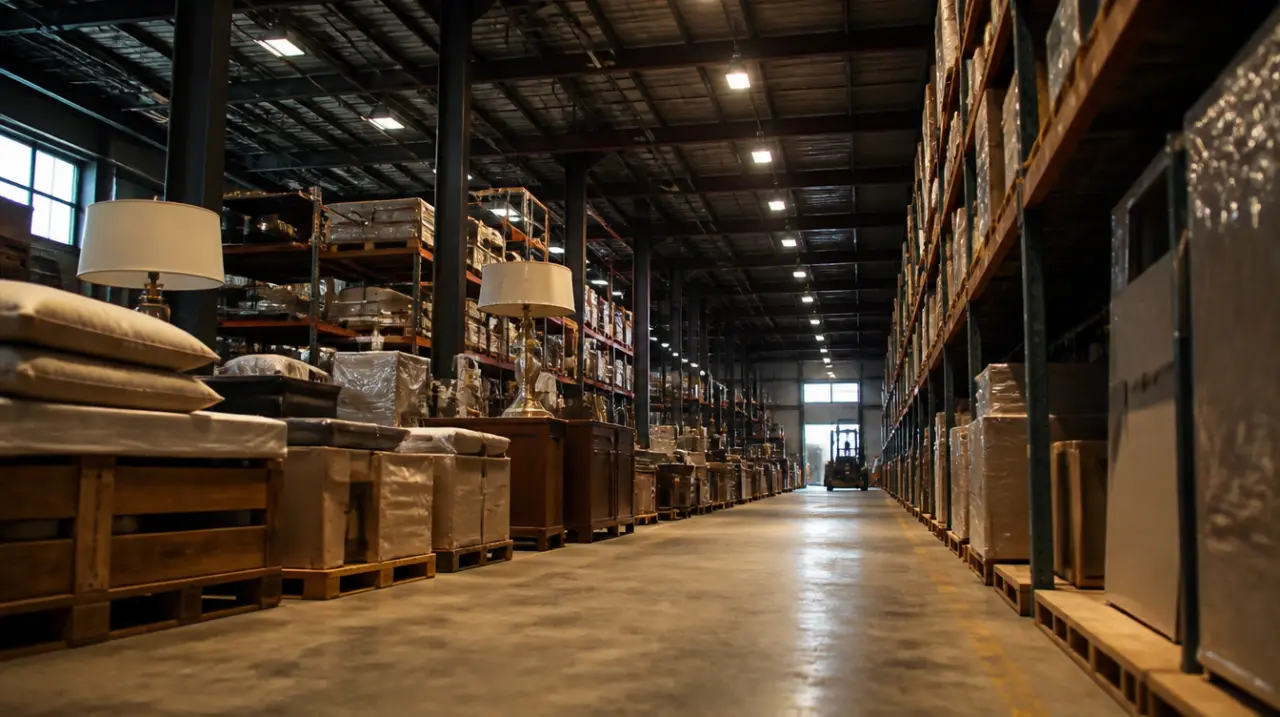
- Buffering the schedule. Product finishes production before the site can accept it, so it is held rather than forced onto an unready floor.
- Inspection at intake. Cartons are opened, counted, and inspected on arrival, so damage and shortages are discovered while there is still time to reorder.
- Consolidated delivery. Full room sets are assembled from multiple vendors and delivered to the site together, rather than in fragments that stall installation.
- Damage mitigation. Professional receiving reduces the risk of damaged goods reaching the room, where a defect is far more disruptive to discover.
Warehousing carries cost and risk of its own. Storage fees accrue, and goods can be damaged in a poorly run warehouse, so the warehouse operator is part of the vendor qualification described in how to source hotel furniture. The International Society of Hospitality Consultants treats warehousing, freight, and installation as core elements of capital project governance rather than incidental line items.
Freight and Transportation
Freight is a major cost and a major risk in FF&E delivery. Casegoods and seating are large, heavy, and easily damaged, and the freight plan has to move them from plant to warehouse to site without loss. Key freight considerations include:

- Mode and route. Domestic truckload and less-than-truckload freight for regional production, and ocean freight plus inland drayage for imported goods, each with different transit times and risk profiles.
- Landed cost. Procurement compares vendors on landed cost, which includes freight, drayage, warehousing, and delivery, not the ex-works price alone.
- Schedule exposure. Imported goods add weeks of transit and expose the project to port congestion, customs, and tariffs, which is why the FF&E schedule and timeline builds freight buffer into the plan.
- Freight responsibility. The contract must state who bears freight cost and risk, and at what point title and risk transfer, so a damage claim has a clear owner.
Industry coverage in outlets such as Hospitality Net has repeatedly flagged how freight volatility and supply-chain disruption can move a hotel opening date, which is why freight is planned, not assumed.
Receiving and Inspection
Receiving is the control point that protects the project. Whether goods are received at a consolidation warehouse or at the site, a disciplined receiving process opens, counts, and inspects each shipment against the purchase order and the specification. Receiving inspection catches three failure modes early:

- Shortages, where quantities do not match the order.
- Wrong product, where finish, dimension, or model differs from the approved specification and control samples.
- Damage, where items are broken, scratched, or soiled in transit.
A share of every large furniture order arrives damaged or incorrect, so receiving is not optional. Discovering a problem at intake leaves time to reorder before the installation window; discovering it during installation, or after the room is meant to be guest-ready, forces a scramble that can delay opening. Casegoods are especially prone to transit damage given their size and weight, a point covered in the hotel casegoods guide.
White-Glove Installation
White-glove installation is the professional delivery, unpacking, assembly, placement, and debris removal that turns received goods into a finished room. Unlike a curbside drop, white-glove service brings the product into the space, assembles it, places it per the design layout, protects finished surfaces, and removes all packaging. For hotels, white-glove installation matters because:

- Room sets are placed to the design intent, so furniture layout matches the drawings and preserves required accessibility clearances.
- Assembly is done correctly, so drawers, glides, and hardware function and warranties are not voided by field errors.
- Finished surfaces are protected, since installation often runs alongside final construction cleaning and touch-up.
- Packaging is removed, which on a full-property install is a significant waste-handling task.
Installation is sequenced by floor or wing so that completed areas can be inspected and closed while work continues elsewhere. Trade publications such as Hotel Management regularly document how installation sequencing protects both the schedule and the quality of the finished product.
The Punch List and Project Closeout
The punch list is the documented record of every defect, shortage, and deviation found during installation and final walkthrough, and closing it is how the FF&E scope is formally accepted. A rigorous punch list process:

- Inspects each installed room against the specification and the approved control samples.
- Logs every deficiency with location, description, and responsible party.
- Assigns resolution to the vendor, installer, or warehouse based on where the fault originated.
- Tracks each item to closure with a re-inspection, so nothing is quietly dropped.
The punch list is also the mechanism that enforces vendor accountability. Because responsibility for a defect may lie with the manufacturer, the freight carrier, the warehouse, or the installer, a clear chain of custody from order through receiving to installation lets the owner assign each punch item correctly and recover the cost. Retaining part of the payment until the punch list is closed gives the owner leverage to see defects resolved.
Installation Sequencing and the Opening Date
On new-build and full-renovation projects, FF&E installation does not happen in a vacuum, it interleaves with the tail end of construction, final cleaning, and pre-opening operations. Sequencing this correctly is what protects the opening date. Furniture cannot be installed into a space that is still an active construction zone, because finished goods will be damaged by trades still working overhead, yet installation cannot wait until every last construction item is closed, or there is no time left before opening. The practical answer is a floor-by-floor or wing-by-wing handover, where construction completes and cleans an area, FF&E installs into it, and the area is inspected and locked down while work continues elsewhere. This staged handover requires tight coordination between the general contractor, the installer, and the operator, and it is one of the reasons the FF&E schedule and timeline has to be integrated with the construction schedule rather than run separately.
Place receiving and installation alongside inspections and staff training using Before It Opens’ opening timeline.
Insurance, Risk Transfer, and Documentation
A large FF&E delivery moves through several parties before it reaches the room, and each handoff is a point where damage can occur and where liability has to be clear. The contract documents should state who carries insurance on the goods at each stage, at what point risk transfers from vendor to warehouse to owner, and how claims are filed and resolved. Photographic documentation at receiving, and again at installation, creates the evidentiary record that makes a damage claim enforceable. Without that documentation, a dispute over who damaged an item becomes unwinnable, and the owner absorbs a cost that should have fallen on a vendor or carrier. Treating risk transfer and documentation as part of the logistics plan, rather than an afterthought, is what turns the punch list from a wish list into an enforceable accountability tool.
Logistics Is Part of the Buy
The lesson for owners and procurement teams is that installation and logistics are part of the furniture purchase, not a separate afterthought. Warehousing, freight, receiving inspection, white-glove installation, and the punch list should be planned and budgeted from the moment the specification is issued, and responsibility for each should be written into the contract. Handled with the same discipline as specification and sourcing, FF&E logistics is what actually delivers a compliant, on-budget, guest-ready property on the date it has to open.